EN
EN

Why Desk and Chair Height Matters More Than Many Schools Realize
The relationship between desk height and chair height directly affects a student's posture, comfort, and ability to concentrate over a six-hour school day. When a desk surface sits too high, students compensate by raising their shoulders to write, which strains the neck and upper back over hours of sustained use. When the seat is too low relative to the desk, students tend to lean forward or hunch over their work, compressing the spine and restricting breathing. These postural habits, repeated daily over the course of a school year, can contribute to long-term musculoskeletal discomfort. Research on ergonomics in educational settings consistently shows that appropriately sized student desk and chair combinations reduce fidgeting and improve sustained attention during seated tasks. For school administrators and facility managers who are evaluating a student desk procurement, understanding how to match desk and chair height to specific age groups is an investment in classroom effectiveness, not just a checkbox on a furniture specification sheet.
Matching Student Desk Height to Age and Activity Type
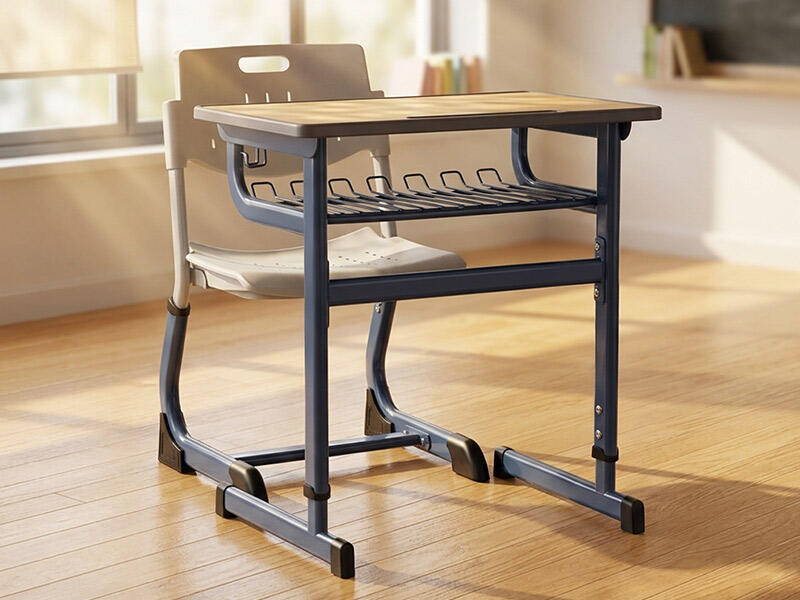
A student desk serving a first-grade classroom must meet entirely different dimensional requirements than one used in a high school science lab. Industry practice recognizes several standard height bands that correspond to broad student age ranges. For early primary grades, a desk surface height of approximately 52 to 58 centimeters accommodates students who are typically reading, drawing, and completing short writing exercises. Upper primary desks, with surface heights in the 64 to 67 centimeter range, provide the additional clearance needed by growing students. Secondary school environments generally require desk surfaces at 70 to 76 centimeters, allowing enough legroom underneath for taller adolescents without positioning the work surface above comfortable arm level. Beyond these fixed-height categories, an increasing number of schools are selecting height-adjustable student desk models. These allow a single piece of furniture to accommodate multiple grade levels, which is especially practical for schools that repurpose classrooms between different age cohorts or operate in multi-use spaces. Adjustable desk frames using steel tube construction and a durable wood desktop can shift through a range of positions while maintaining the structural stability required in an active classroom.
How Chair Dimensions Complete the Height Equation
Selecting the correct student desk height solves only part of the problem if the accompanying chair is mismatched. A well-proportioned desk-chair pair positions the student so that feet rest flat on the floor, knees bend at approximately 90 degrees, and the desk surface sits just below elbow height when arms are relaxed at the sides. For a typical primary school chair, such as models with molded plastic shells supported by steel tube frames, the seat height often falls between 30 and 38 centimeters depending on the target grade. Secondary-level chairs tend to range from 40 to 46 centimeters in seat height. When chairs are too tall, students' feet dangle, which reduces stability and encourages slouching. When chairs are too short, the lap angle becomes cramped and students unconsciously shift into sideways sitting positions that twist the spine. Many manufacturers, including ZOIFUN who produces adjustable classroom furniture for markets across 133 countries, offer matched student desk and chair sets that are calibrated at the design stage to ensure proportional alignment between the two components. This pre-matched approach removes the guesswork from procurement and provides a consistent ergonomic experience across all classrooms in a facility.
The Materials That Support Proper Height Adjustment Mechanisms
Height adjustability in a student desk depends as much on the materials used as it does on the design concept. Steel tube frames, commonly made from cold-rolled steel with tube thicknesses ranging from 1.2 to 1.8 millimeters, provide the structural backbone for adjustable legs. These frames undergo a multi-step finishing process that typically includes acid-pickling, phosphating, and epoxy powder coating to resist corrosion in humid classroom environments. The desktop surface, whether made from medium-density fiberboard with laminate or solid wood, must remain rigid and flat after repeated height adjustment cycles and years of daily student activity. A desk that wobbles at any height setting disrupts writing and fine motor tasks. Quality manufacturers subject their frames to inclined pull testing and batch-level pressure testing before shipping, verifying that the locking mechanisms at each adjustment notch maintain their hold under load. For schools operating in regions with high humidity or seasonal temperature shifts, the anti-rust coating on steel components and the formaldehyde emission level of wood panels are relevant factors that directly influence the service life of adjustable student desk units.
Case Perspective: Equipping a Multi-Grade Primary School
Consider a primary school serving grades 1 through 6 with 18 classrooms and approximately 540 students. The school plans to replace aging fixed-height desks that have served for over a decade. The administration needs furniture that can accommodate students aged 6 to 12 across multiple rooms. After evaluating available options, the procurement team selects a combination approach: fixed-height student desk and chair sets for grade-specific classrooms where enrollment is stable year to year, and a quantity of height-adjustable desks for shared resource rooms that serve multiple grade levels. The adjustable desks, with steel tube frames and wood desktops, can shift through a range sufficient to cover the 52-centimeter to 67-centimeter surface height band. The matching chairs use molded plastic seat shells on steel frames with proportional seat heights. This mixed strategy controls cost on the majority of fixed classrooms while providing flexibility where it is most needed. The school reports that the new furniture, by aligning desk and chair heights to each age group, noticeably reduced the number of students complaining of back discomfort during parent-teacher conferences in the following semester.
Key Points to Verify When Selecting a Student Desk
Procurement teams should begin by confirming the specific height ranges that each student desk model supports, not relying on generic labels such as "adjustable" or "primary school size" alone. Second, verify that the chair seat height included in matched sets corresponds to the same age band as the desk. A desk suited for a 10-year-old paired with a chair designed for a 7-year-old will create the same ergonomic problems that height-adjustable solutions are meant to solve. Third, examine the materials used in the height adjustment mechanism. Steel tube legs with corrosion-resistant finishes maintain their adjustment precision far longer than plastic mechanical components. Fourth, request documentation on relevant furniture safety and quality standards. Products meeting international benchmarks such as EN, BIFMA, and FSC provide independent verification of structural integrity, material safety, and responsible sourcing. Finally, if the school serves students across a wide age range, consider purchasing a small quantity of adjustable student desk samples before committing to a full order. Testing a few units in actual classrooms reveals practical factors such as how quickly teachers can adjust heights between class periods and how students of different sizes interact with the furniture across an entire school day.
Common Questions About Student Desk Height Selection
Q: Is there a single standard height for student desks across all grade levels?
A: No. Different age groups require different desk and chair heights because student body dimensions change significantly between kindergarten and secondary school. Primary students typically need desk surface heights in the 52 to 58 centimeter range, while secondary students require 70 to 76 centimeters. Fixed-height desks are manufactured in distinct size bands targeting specific grades, and adjustable-height models span broader ranges to accommodate multiple age groups within a single product design.
Q: How can a school verify that a student desk and chair set is ergonomically correct before purchasing in bulk?
A: The most practical approach is to request product samples and conduct in-classroom testing with students from the intended age group. Observe whether students can sit with feet flat on the floor, knees at approximately a right angle, and elbows at or just above the desk surface. Also note whether the desk remains stable during writing activities and whether the chair allows the student to shift position without tipping. Many suppliers, particularly those with extensive school furniture experience, will provide sample units for evaluation.
Q: Are adjustable-height student desk options durable enough for daily classroom use over multiple years?
A: When constructed with steel tube frames of adequate thickness, typically 1.2 to 1.8 millimeters, and finished with anti-rust coatings, adjustable-height desks are comparable in durability to fixed-height models. The critical components are the locking mechanisms at the adjustment points, which should be tested under representative loads during quality control. Schools should look for products that are backed by industry standards such as BIFMA to establish confidence in long-term structural performance.
Table of Contents
- Why Desk and Chair Height Matters More Than Many Schools Realize
- Matching Student Desk Height to Age and Activity Type
- How Chair Dimensions Complete the Height Equation
- The Materials That Support Proper Height Adjustment Mechanisms
- Case Perspective: Equipping a Multi-Grade Primary School
- Key Points to Verify When Selecting a Student Desk
- Common Questions About Student Desk Height Selection